TECHNOLOGY
Chatbot news use reaches 9 per cent while comfort with AI-written copy stays at 12 per cent
A third annual Reuters Institute survey across nine countries finds generative AI an increasingly important intermediary for information, but only 12 per cent are very or fairly comfortable with news made entirely by AI.
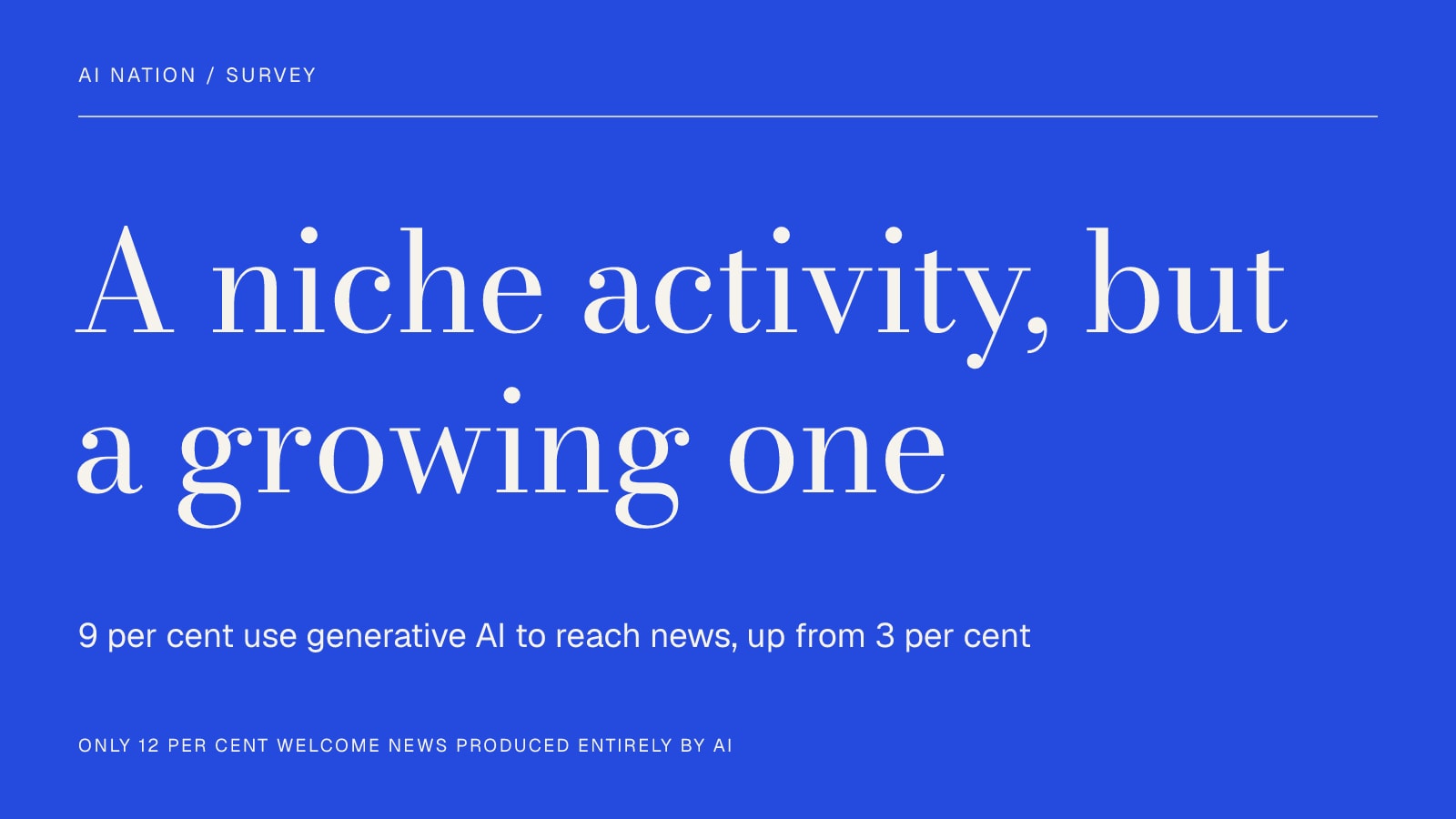
Nine per cent of respondents now use generative artificial intelligence to reach news, up from six per cent in 2025 and three per cent in 2024, according to the third annual report on generative AI from the Reuters Institute. The same online survey, conducted between August and September 2026 in Argentina, Australia, Denmark, Finland, France, Japan, Norway, the United Kingdom and the United States, puts general use of such tools to obtain information at 38 per cent, against 24 per cent a year earlier and 11 per cent in 2024. The figures place chatbots and assistants among the routes by which audiences now reach information, a shift with direct consequences for how publishers are found and paid.
News remains the smaller errand. Asking follow-up questions about a story (49 per cent) outpaces requests for the latest updates (46 per cent), for a news source (39 per cent) and for a summary of a story (38 per cent). Across information tasks generally, the report lists research (24 per cent), asking for advice (20 per cent), generating ideas (14 per cent) and summarising text (13 per cent) as the leading uses. ChatGPT retains the lead, followed by Gemini, Copilot and Claude. Use of AI agents stands at 14 per cent and is more widespread among younger users, those on higher incomes and certain professions.
Comfort with AI in the newsroom is narrow. Only 12 per cent say they feel very or fairly at ease with news created entirely by artificial intelligence, a figure rising to 19 per cent where some form of human supervision is envisaged; both are broadly unchanged since 2024. Respondents are more open to AI for tasks such as translation and grammatical correction. In six countries the prevailing opinion is that AI will make news production cheaper, a 34-point gap between those expecting costs to fall and those expecting them to rise, and more up to date, a 19-point gap, but also less transparent, minus 10 points, and less reliable, minus 17 points.
Differing forms of generative AI are becoming ever more relevant intermediaries of information, both when used intentionally and accidentally, the authors Felix M. Simon, Rasmus Kleis Nielsen and Richard Fletcher write, in remarks translated from the Italian reporting. Among the possible consequences they list a reduction in traffic from search engines and a growing tendency for audiences to turn to AI systems in place of search engines themselves, with visibility, brand and monetisation becoming more complex for most publishers. A separate Reuters Institute analysis published in February 2026 projected that traffic to sites would fall 43 per cent over three years. The ANSA accounts do not give the survey's sample size, and the nine-country, online-only design limits generalisation beyond those markets. The next annual edition of the survey is the point at which these trend lines can be measured again.