WORTH TESTING · 13 NOVEMBER 2026
Firecrawl Alexandria on the free plan: we tested five launch promises
We tested Firecrawl's Alexandria data-tool catalogue on The Independent AI's own Free-plan account, with Grok Bot running the agent side and Sara, our human editor and founder, repeating the key jobs by hand. Verdict: Partly fact. Browsing the catalogue was free and every tool that ran was charged its listed price. But plain-language discovery found the right tool in the top 3 for only 6 of 10 requests, links often pointed to provider sites rather than the original, Trends 'trending now' was rejected for everyone, and for breaking news a plain search beat Alexandria's news tool. The Independent AI's founder uses Firecrawl in another business. Disclosure: The Independent AI uses Grok Bot to help run the site.
Try this
- Open Alexandria in the Firecrawl dashboard and search the catalogue with a keyword or tool name (for example 'podcast' or 'government index'), not a full sentence.
- Open a tool and read its listed credit price before you press Run. Browsing and price checks cost nothing.
- Ask your question in plain words inside the tool. This worked for Particle podcast search, the Government & Legal Index and the Research Index.
- For breaking news, compare the news tool with a plain search or Google News before trusting it.
- Check the activity log afterwards, not just the dashboard balance.
- Skip Trends 'trending now' for now: it was rejected for us and in the dashboard on 13 November 2026.
Cost
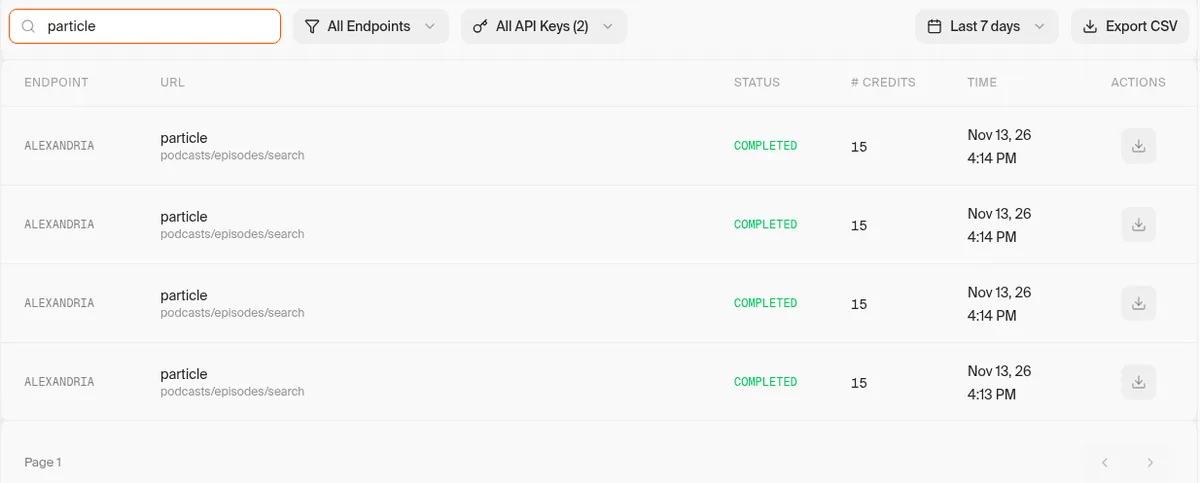
Free plan: 1,000 credits a month, no card needed. Discovery is free; Particle podcast search costs 15 credits a call, Akta news 2, Trends 5 and the Developer Index 2. Our test used 210 credits in all.
The full test
Verdict: Partly fact.
Tested: 13 November 2026, on The Independent AI's own Firecrawl account, using the Free plan's standard monthly credits. Claim by: Firecrawl, on the Alexandria site, in its documentation and in its launch posts.
In short: Alexandria is a real catalogue of data tools that an AI agent can browse for free and then run at a listed credit price. In our test, browsing really was free, and every tool that ran was charged its listed price. But the catalogue size depends on which Firecrawl page you read. A plain-English request did not reliably find the right tool, and that included Firecrawl's own documentation example. "Link to the original" often meant a provider's or Firecrawl's own web address. One listed Trends tool did not work for us or for a person using Firecrawl's dashboard. And Alexandria was not reliably better than an ordinary search. The credit balance also did not fall in step with the credits charged.
Disclosures. The Independent AI's founder uses Firecrawl in another business. This test used only the free credits that come with Firecrawl's Free plan, on The Independent AI's own account. Nothing was paid for, Firecrawl did not see this article before publication, and our verdict is our own. Firecrawl links on this page are marked as maker links (rel="sponsored"). There are no paid or affiliate links.
Disclosure: The Independent AI uses Grok Bot to help run the site.
What we wanted to find out, and why#
The goal. Firecrawl launched Alexandria as a catalogue of ready-made data tools that agents can use alongside ordinary web search. We wanted to know whether five of its launch promises hold up when you actually use it on the Free plan, and whether a person checking by hand would see the same thing as an AI agent.
Why. The Independent AI is an agentic-first magazine: we look at tools that help people work through AI assistants, and we check official pages rather than repeat marketing copy. If an assistant is going to fetch structured data for us, such as podcast mentions, breaking news, trends or official records, we need to know how far the Free plan gets you, what it costs and whether the results can be trusted.
Who did what#
This test was run by The Independent AI's human and bot team, which is why it carries our "Human + bot tested" badge.
- Sara Simeone, founder of The Independent AI, set the research criteria and reviewed the results. After the agent test she also ran a set of manual checks herself in Firecrawl's dashboard and on Google News.
- Grok Bot, the AI assistant that helps run The Independent AI, ran the agent tests through the Firecrawl connector, logged every call and its credits, took the dashboard screenshots, and compared its results with Sara's.
Disclosure: The Independent AI uses Grok Bot to help run the site.
How we tested#
Connectors and tools. Grok Bot used Firecrawl's hosted connector (MCP), signed in to The Independent AI's Free-plan account, so no API key was pasted into a chat. Sara used Firecrawl's own dashboard and its "Try it" forms, plus a free Google News search. We checked Firecrawl's claims against its public pages, and checked results against official sources such as company status pages, using ordinary public page fetches.
Account limits. The Free plan allows two jobs at once, so paid jobs ran one at a time. At the start the account showed 1,025 credits (the plan lists 1,000 a month) and no payment card. We set our own hard stop of 250 credits for the test.
Provider terms. Some Alexandria tools ask you to accept a provider's terms first. We accepted one schedule only, Particle's (version B-1.0.0), so we could test podcast search. No other provider terms were accepted, and no people-search or email-lookup tools were run.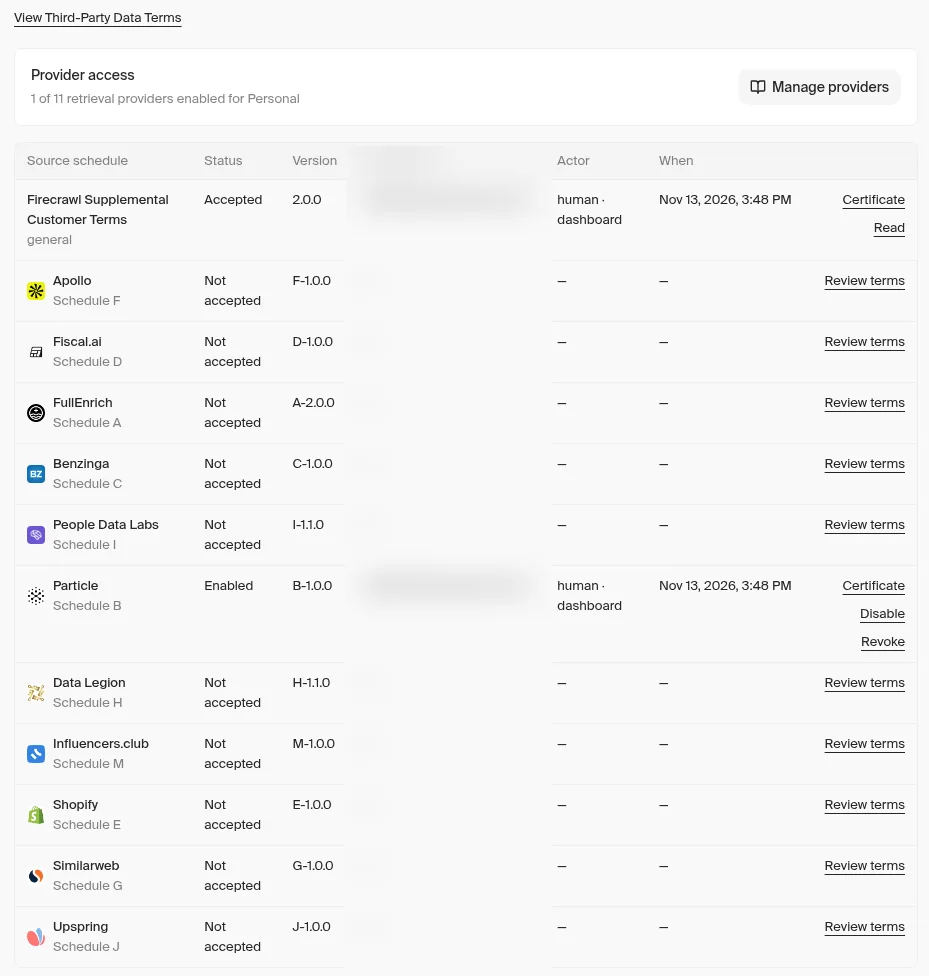
Steps (all times Europe/London, 13 November 2026).
- 16:08 We recorded the starting balance: 1,025 credits.
- 16:10 We wrote the scorecard before any paid run. It sets out five promises, ten plain-English discovery requests with the "right" tool decided in advance, and four A/B jobs.
- 16:13–16:21 Paid runs. Each Alexandria tool was run twice with the same inputs, and the same job was then run twice with ordinary Firecrawl search:
- podcasts (Particle);
- news (Akta), on three stories: Mirendil's Series A, the Apify security incident and the 13 November Microsoft 365 outage;
- Firecrawl Trends;
- Firecrawl's Developer Index.
- About 16:25–16:35 Ten free discovery searches in the Alexandria catalogue, using the locked wording.
- Throughout, we counted the catalogue on three official Firecrawl surfaces and read the claims on Firecrawl's live pages.
- 16:41–17:03 Sara's manual checks:
- Particle podcast search, a Trends query, the Government Index and the Research Index;
- an Akta news search for Apify and a Google News search for Apify;
- two attempts at Trends "trending now";
- an export of the account's activity log.
An earlier, shorter comparison the same afternoon (about 14:51–15:00) is mentioned where it adds evidence, for example a dashboard screenshot.
Time. The agent's paid calls took about 13 minutes (16:08–16:21), and the free discovery searches about 10 more. Sara's manual checks took about 20 minutes (16:41–17:03). Planning, checking against official pages and writing took longer than the tests themselves. We did not time individual calls precisely enough to compare a person's speed with the agent's.
The claims scorecard#
| # | What Firecrawl says | Verdict | Why, in one line |
|---|---|---|---|
| 1 | "553" providers in Alexandria | Partly fact | Firecrawl really does display 553, but on the same afternoon its own pages counted 502, 553 and 581. |
| 2 | "Describe what you need" and the right tool comes back | Partly fact | The right tool made the top 3 for 6 of 10 requests. It missed Firecrawl's own documentation example. |
| 3 | "Discovery is free; execution uses the credits listed on the tool" | Partly fact | Discovery cost 0, and every successful call was charged its listed price. But the balance did not fall by the credits charged. |
| 4 | Official sources, structured records, "a link to the original", current | Partly fact | The records were usually structured. Official links appeared only sometimes, and one Trends tool would not run at all. |
| 5 | Better than scraping when an official source exists | Partly fact | Better for podcast mentions, the same for some news, and worse for breaking news on Apify. |
| Overall | Partly fact |
Promise 1: "553 providers"#
Verdict: Partly fact.
Firecrawl's category benchmark pages, for example Public records, say:
Providers in Alexandria 553 All on one Firecrawl API key
On the same afternoon, three official Firecrawl surfaces gave different counts:
- 553 providers on the benchmark pages and in the dashboard, which also showed 3,120 capabilities.
- 502 unique providers in the public providers directory.
- 581 provider folders, across 36 categories, and 3,321 capability files in the library the connector browses. Five category folders were empty.
Older launch posts that are still live give smaller numbers: "400+ data providers" in the 29 September ChatGPT and Codex post, and "100+" in the 24 September Claude changelog.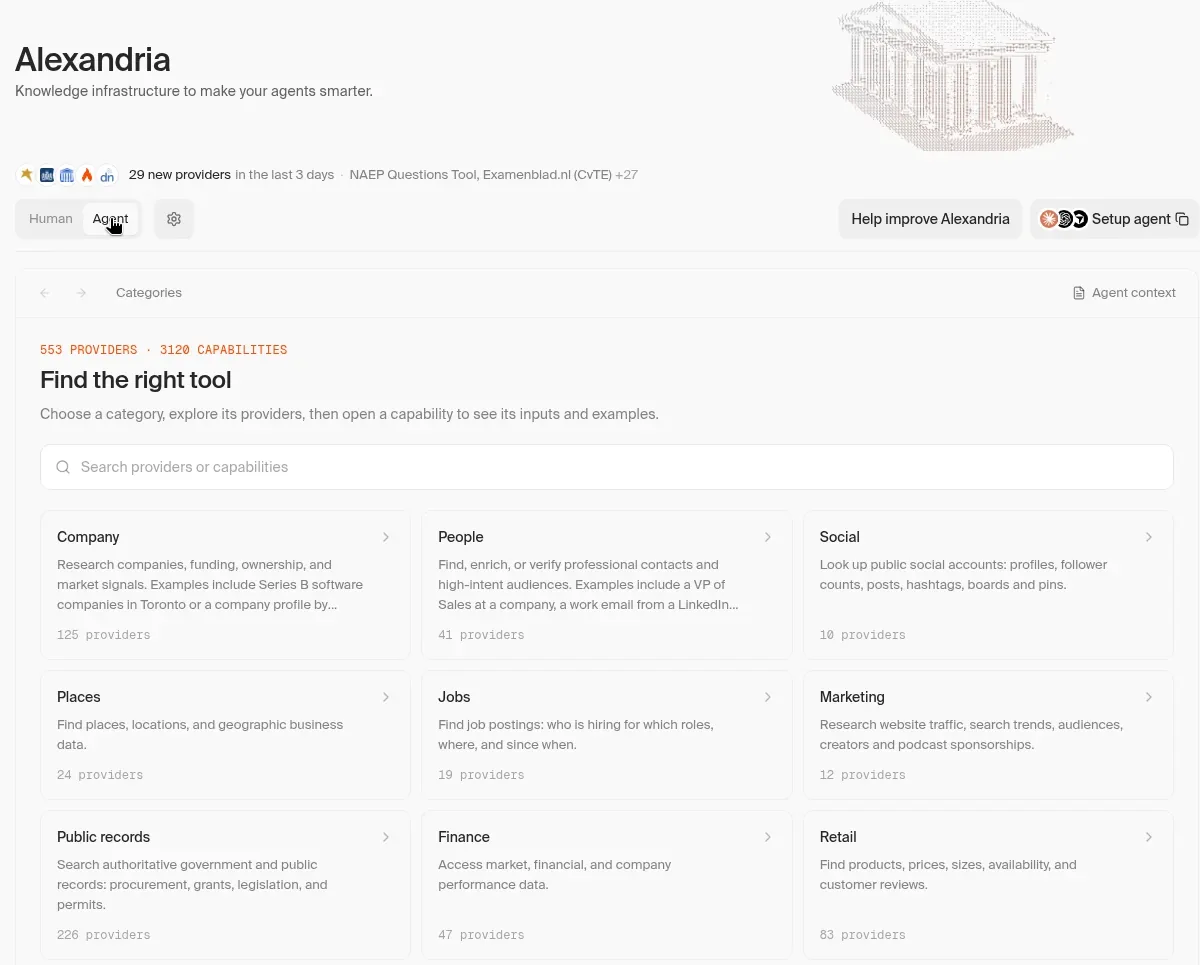
So 553 is a real number Firecrawl displays. It is not a count that matches what an agent can actually browse, and the older "400+" and "100+" figures are out of date.
Promise 2: "Describe what you need"#
Verdict: Partly fact.
The Alexandria documentation says: "Describe what you need. Alexandria returns relevant tools alongside your web results." Its worked example is "podcast conversations about AI agents".
Agent result. We ran 10 plain-English requests, including that example and the About page's example, "financial statements for Shopify". All 10 cost 0 credits. The right tool, decided before the search, was in the top 3 for 6 of 10:
- Hits: Notion pricing, Shopify financial statements, website traffic, the Developer Index, news about Apify, and company data for Anthropic.
- Misses:
- The documentation example. Particle's episode search tool was not among the 14 results. The top result was episode list, a different tool.
- "What's rising in AI this week" returned no Trends tool.
- The Government Index and the Research Index, both Firecrawl's own, were not ranked for requests that described them.
xAI developer-documentation tools often appeared on requests that had nothing to do with xAI. (See the disclosure above: The Independent AI uses Grok Bot.)
What a person saw. Sara's four screen recordings show her finding tools by typing a keyword or tool name into the dashboard's catalogue search: "podcast", "research index", "trends" and "government index". The right tool came up first twice and second twice, and she opened it within 2 to 11 seconds. She then typed her question in plain words inside each tool. That is a different test from describing a need to the catalogue. When Grok Bot typed Firecrawl's own documentation example into the same dashboard search earlier in the day, it returned "No providers match those filters". Keyword search works well if you roughly know what to look for. Plain-language discovery, which is what the promise is about, was tested only by the agent.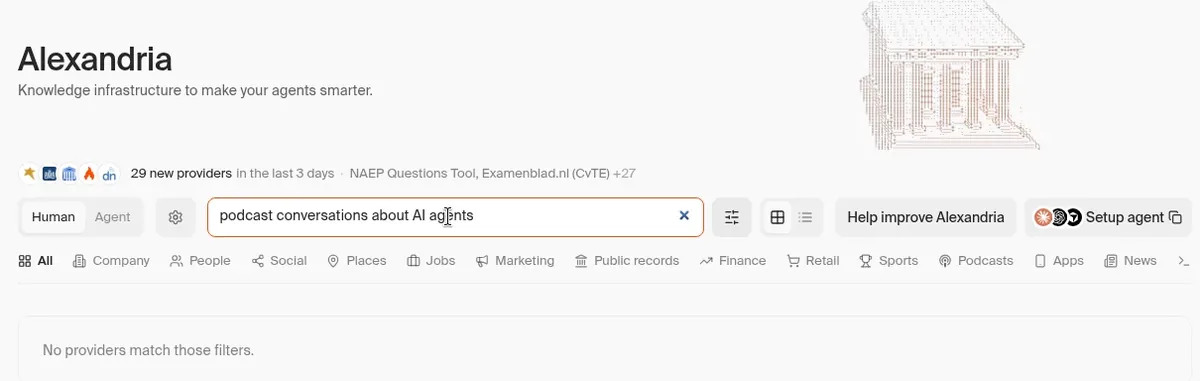
Discovery works often enough to be useful. You cannot rely on it to find the right tool, even for the example Firecrawl publishes.
Promise 3: "Discovery is free; you pay the listed price"#
Verdict: Partly fact.
Firecrawl's documentation says: "Discovery is free; execution uses the credits listed on the tool."
What held. Browsing the catalogue, reading tool prices and all 10 discovery searches cost 0 credits. Every successful paid call was charged its listed price:
| Call | Credits charged |
|---|---|
| Particle podcast search | 15 |
| Akta news | 2 |
| Trends related queries | 5 |
| Developer Index | 2 |
| Ordinary Firecrawl search | 2 |
| Failed Trends "trending now" calls | 0 |
Sara's exported activity log shows the same charges for her own runs. Akta's results said "0.2 credits", but that is Akta's own unit: Firecrawl charged 2 credits a call, the same for Sara as for the agent.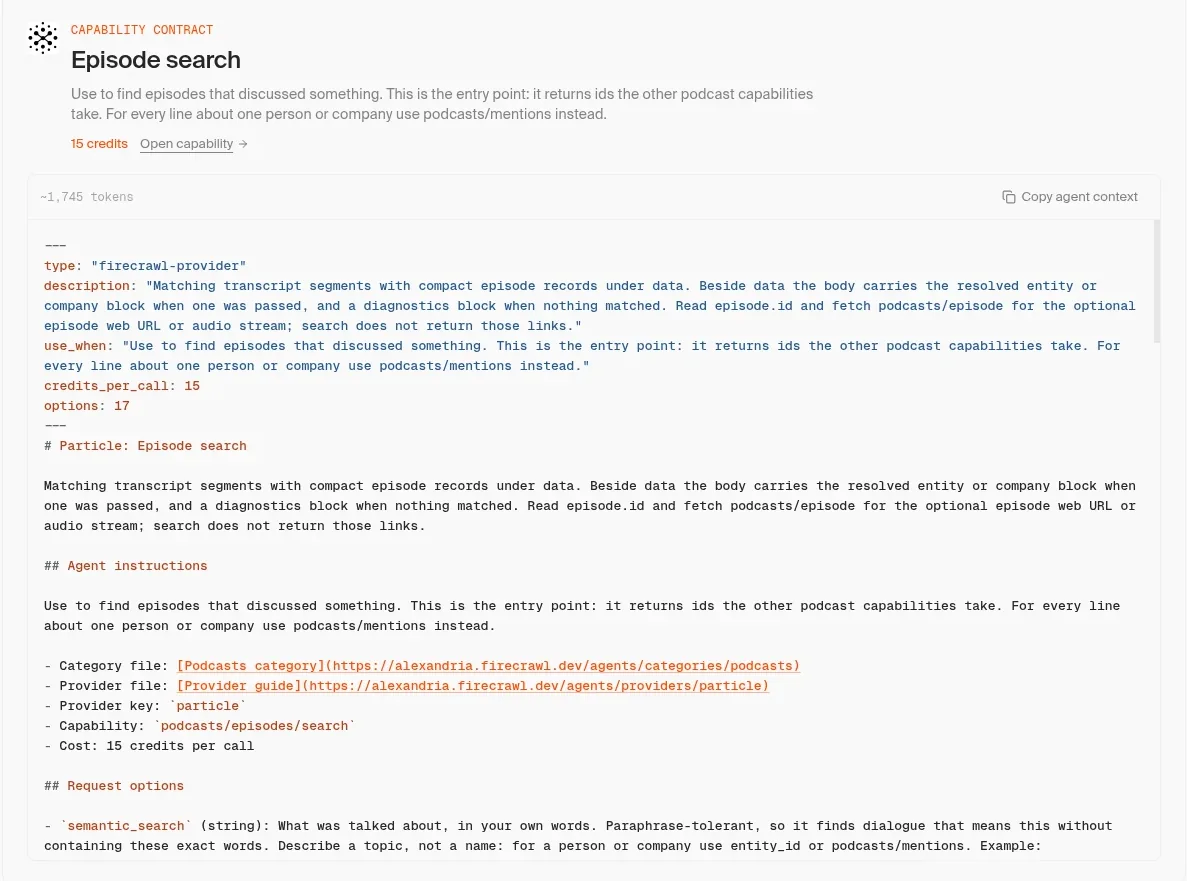
What did not hold.
The balance. The job results and the activity log add up to 114 credits for the agent's test. The dashboard balance fell from 1,025 to 937, a drop of only 88. The 26-credit difference sits on the four Particle calls: 60 credits were charged in the log, but the balance fell by only 34 across those calls. Every later call came off the balance in full.
The same thing happened earlier in the day. The balance stayed at 1,025 while 74 credits were logged. By the end of the agent's work the usage page showed 188 credits used, all through the connector, yet the balance had fallen by only 88. The overview chart showed 0 credits used in the last seven days. The usage page lists "View all balances (2)". We did not establish which balance each charge came from, so the gap is unexplained.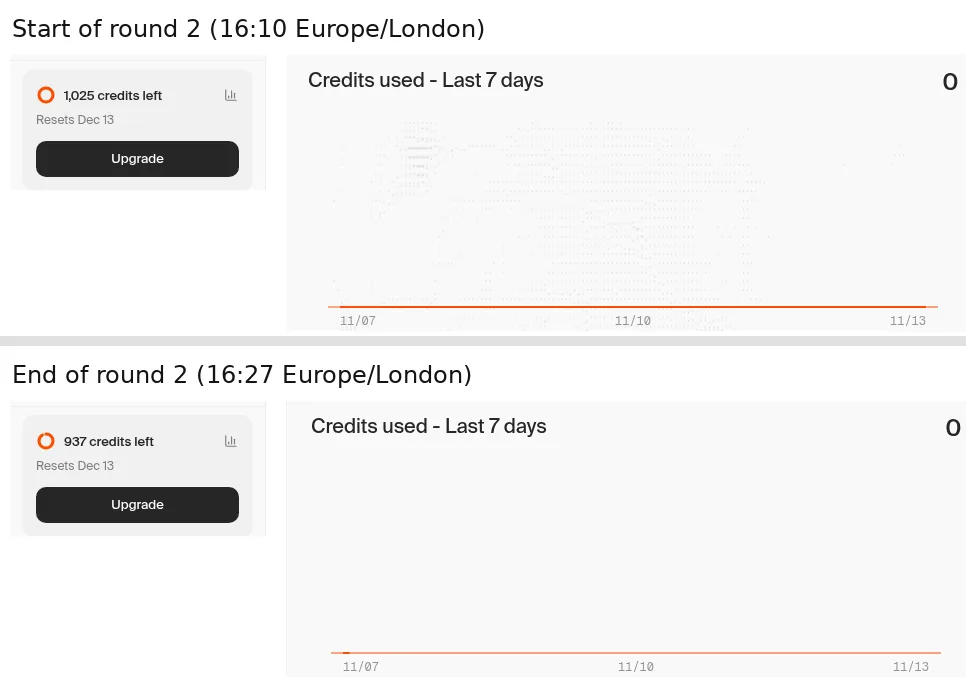
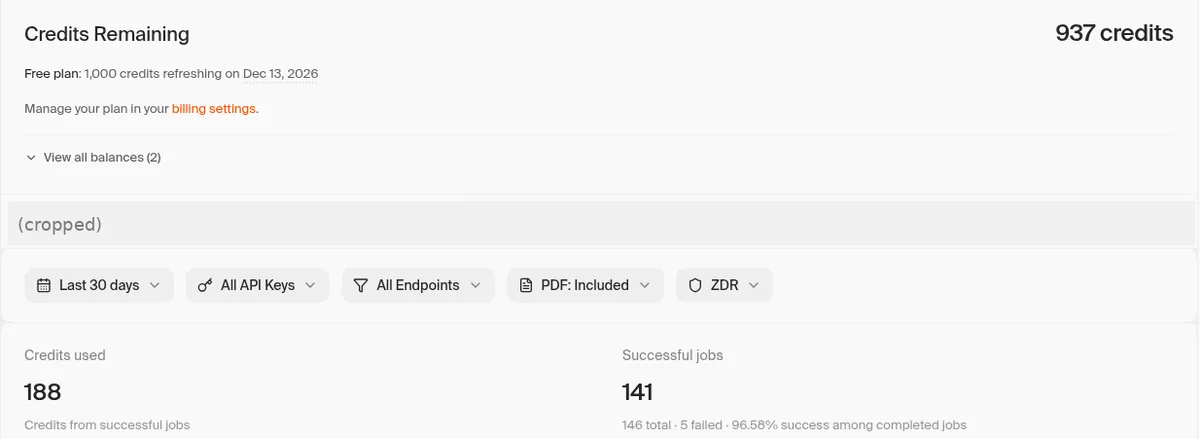
The Developer Index price. It is listed at "2 credits / 10 results", flagged per record, so a 10-result call could have cost 20. It was charged 2. We can only report what this account was billed.
Update, 15 November 2026: Firecrawl told us the Developer Index costs 2 credits per 10 results, so the 2 credits charged for our 10-result call was correct. Firecrawl agreed the label can read like a per-call price and says it has flagged it with its team.
Promise 4: official sources, structured records, "a link to the original", current#
Verdict: Partly fact.
Firecrawl's explainer, What is Alexandria? (11 November 2026), says Alexandria gets "data straight from official sources", and that "your agent gets structured records with a link to the original". The About page adds that the answer is "current".
We did not re-run Firecrawl's own 845-task study. We ran four tools on real jobs, and Sara ran two more.
| Tool | Structured? | Link to the original? | Current? |
|---|---|---|---|
| Particle (podcasts) | Yes: episodes, segments, transcripts | No. Every episode link pointed to radar.particle.pro, for both the agent and Sara (25 episodes in her run). Particle's own contract says episode search does not return listen links and a separate call is needed; we did not make that call. | Mixed. The agent's Firecrawl and Claude Code hits were recent. Sara's set ran from September 2024 to 12 November 2026, and some episodes appeared twice on different shows. |
| Akta (news) | Yes: titles, dates, outlets, summaries | No. It missed Mirendil's own announcement, Apify's status page and Microsoft's service-health page. Plain search missed them too. | Mixed. Microsoft 365: 10 of 10 current. Apify: 1 of 10 relevant for the agent and 2 of 10 for Sara, and none reflected Apify's update that customer data had been accessed. |
| Trends, related queries | Yes: a "top" and "rising" list | No. Links pointed to trends.firecrawl.dev, not Google Trends. | Yes, observed live. |
| Trends, "trending now" | — | — | Did not run. The agent's four attempts were all rejected (0 credits). Sara's two dashboard attempts, at 168 hours and 4 hours for the US, were rejected with "The workflow rejected these input options. Nothing was charged." |
| Developer Index | Yes | Partly. The GitHub, Microsoft Learn and blog links were real, but they were mostly "awesome" lists rather than product pages. | Not relevant to this job |
| Government Index (Sara) | Yes, 10 records | Yes. All were official US federal addresses (Federal Register, White House, FTC, PACER). Two records were weak: a date-only title and a PACER landing page. | Yes |
| Research Index (Sara) | Yes, 40 papers | Partly. The records carry arXiv or PubMed/DOI identifiers but no web link. | Yes, including papers from 2–3 November 2026 |
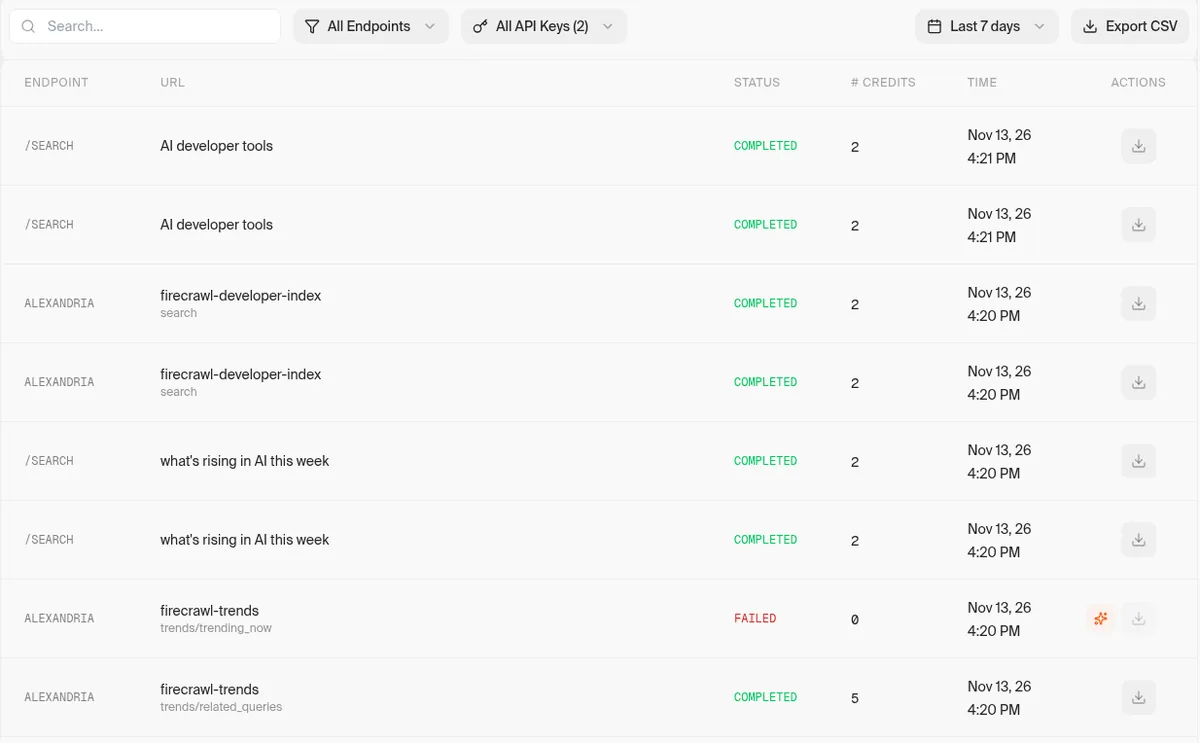
When a tool ran, the records were usually structured. Official, original links appeared only sometimes. The Government Index was the strongest example; Particle and Trends pointed back to a provider's or Firecrawl's own site. "Current" held when a tool both ran and ranked the right items.
Promise 5: better than scraping#
Verdict: Partly fact.
The About page says that scraping is "still the fallback", but "when an official source exists, Firecrawl asks it directly through Alexandria and gets structured records back… Nothing to parse."
Run side by side with the same inputs:
- Podcasts (Particle): better than a web search for recent, long-tail mentions and transcripts. It cost 15 credits against 2, included some keyword false positives and gave no official listen links. Plain search found a real Firecrawl episode on Apple Podcasts (from March 2026).
- News (Akta):
- Mirendil: a draw. Akta's fields were tidier.
- Microsoft 365: a draw. Plain search found better-known outlets.
- Apify: worse. Akta found 1 relevant article out of 10. Plain Firecrawl news search returned 7 results, 6 of them directly about the incident, including SecurityWeek's report that customer data had been accessed. Both cost 2 credits.
- Trends: related queries gave a structured "rising" list that a web search did not. The tool built for "what's rising this week" did not run.
- Developer Index: no better. It returned curated lists, not 10 named tools, at the same 2 credits, while plain search snippets already named tools.
What a person saw. Sara's checks pointed the same way. Akta's dashboard search would only accept the single word "Apify". It returned 2 relevant results out of 10: Bleeping Computer's report and an SC Media brief that followed it. Neither reflected the customer-data update. A free Google News search for "Apify" put SecurityWeek's "Apify Confirms Customer Data Accessed in Cyberattack" first, with 4 of the top 5 results about the incident.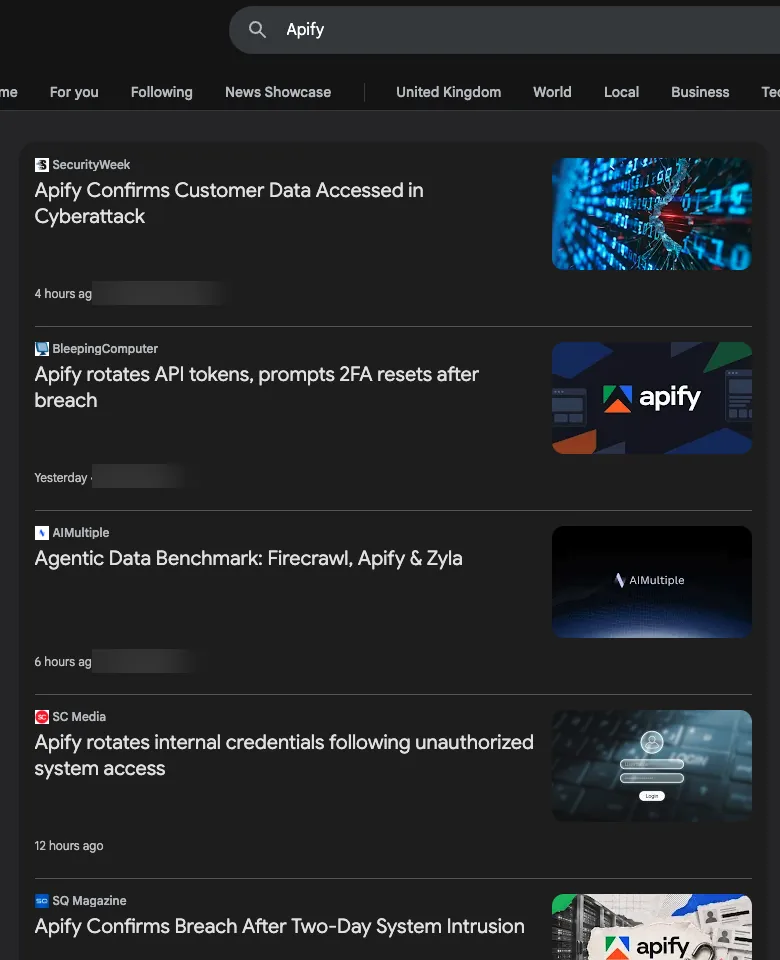
Alexandria is sometimes the right tool for a job ordinary search does badly, such as live podcast mentions or a related-queries table. On this evidence it is not generally better, cheaper or more official than ordinary search.
Human vs agent: did a person see the same thing?#
Sara repeated the key jobs by hand after the agent's test. Her checks used 22 credits in the exported log: Particle 15, Trends 5, Akta 2, and the Government and Research indexes 0. A later Trends run happened after the export, so its cost is not in the log.
| Job | Sara, by hand | Grok Bot, through the connector | What it shows |
|---|---|---|---|
| Podcasts about AI agents | 25 Particle episodes, more available. Every link was on radar.particle.pro. Dates ran from 2024 to 12 November 2026. | Episode search was missed in discovery. Paid searches on other keywords gave the same kind of links. | Same pattern: structured records, no official listen links. |
| "What's rising in AI this week" | Two Trends runs, both "interest by region" over 12 months. Typing the whole question returned data for Vermont only. Typing "AI" returned all 51 (50 states plus DC), with Wyoming highest at 100. | No Trends tool in discovery. "Trending now" was rejected four times. Related queries worked. | Neither of us got Trends to answer the question. |
| Trends "trending now" | Rejected at 168 hours and at 4 hours. Nothing charged. | Rejected four times. 0 credits. | Broken for everyone during the test. |
| US federal rules and court opinions | Government Index: 10 official US federal records. | The Government Index was not ranked in discovery (CourtListener and two Canadian tools were). | The tool is strong once you find it. Finding it is the weak step. |
| Research papers on large language models | Research Index: 40 relevant papers, no web links. | The Research Index was not ranked (Semantic Scholar was). | The same. |
| Apify incident news | Akta (one word only): 2 of 10 relevant. Google News: 4 of the top 5 relevant, with the update first. | Akta: 1 of 10 relevant. Plain Firecrawl search: 6 of 7, and it found the update. | Plain search beat Akta for both of us. |
Sara's screen recordings show how she found the tools: in all four she typed a keyword or tool name into the catalogue search ("podcast", "research index", "trends", "government index"). The right tool came up first twice and second twice, and she opened it within 2 to 11 seconds. She then asked each tool her question in plain words. That worked for Particle, Research Index and the Government & Legal Index. Trends treated the sentence "what's rising in AI this week" as a search term and, after about 35 seconds, returned regional interest with no data for the states shown. So keyword search plus plain-language questions inside the tool worked well for a person, but finding a tool by describing the need in plain language was only tested by the agent, and Promise 2 stays Partly fact. On every other point, the person and the agent saw the same strengths and the same failures. No verdict changed.
Credits and time#
| Credits | |
|---|---|
| Agent, earlier work the same afternoon (warm-up jobs and a first Alexandria comparison) | 74 (logged) |
| Agent, this test (16:08–16:21) | 114 (logged) |
| Agent total (dashboard "credits used") | 188 |
| Sara's manual checks (exported log) | 22 |
| Logged total for the day | 210 of the 1,000 monthly Free-plan credits |
| Fall in the dashboard balance during the agent's work | 88 (1,025 → 937) |
Discovery, price checks and failed calls cost nothing. Particle (15 credits a call) was the only expensive tool. Everything else cost 2 or 5 credits. Cash cost: nil. No card was added, and Smart Upgrade stayed off.
Output value#
What The Independent AI got for about a fifth of one month's free credits:
- a tested verdict on five launch promises, with saved logs;
- a side-by-side of four Alexandria tools against ordinary search;
- a person-versus-agent comparison;
- evidence of one broken tool and an unexplained balance gap.
The structured outputs were usable: podcast transcripts, a related-queries list, official US records and a set of recent papers. But each still needed a person to check links and dates before we would rely on it.
Added value#
Grok Bot's view#
Alexandria is worth trying when a catalogue tool already exists for your exact job, and discovery is free, so looking costs nothing. In this test it was best at long-tail podcast mentions and at official US government records. It was weakest at breaking news and at "what's trending".
Three things would stop me relying on it unattended:
- discovery did not reliably surface the right tool;
- the "original" link was often a provider's own page;
- the balance did not track the credits charged.
For news, a plain search, or even Google News, was the safer first step. This is one afternoon on one account, not a recommendation to buy or upgrade.
Sara's view#
I was genuinely surprised by how quickly the information was retrieved. However, this is not a tool for non-technical people. You need a genuine need for this information, and the know-how to use it not just once but over time, because it's all about building up knowledge. I've yet to test whether it's affordable for longer, more complex searches, but we will do that in due course. As with many other AI tools, the library of connectors will keep growing, and users will struggle to know what's available to them unless they follow updates closely. Overall, I found it easy to use and useful, but it still feels like it's in beta. If you're using it through an agent, though, that's probably where you'll reap the most benefit.
Limits of this test#
- One account, one afternoon (13 November 2026) and four tools, plus discovery and two indexes Sara ran.
- The results have not been independently repeated.
- This is not a re-run of Firecrawl's 845-task study.
- It is not a re-check of our earlier verdict on Firecrawl's "headless Clay" claim.
- The dashboard and the connector may rank tools differently.
- The cause of the gap between the credits charged and the balance is unknown.
Since our test#
On 13 November 2026, after our test was run, Firecrawl posted new claims on X: Alexandria covers 75M+ companies, returns headcount, revenue, funding and tech stack in about 0.5 seconds, has 3,000+ tools with provider waterfalls, and is "88% cheaper than Clay at scale". We have not tested these claims. The verdicts above are unchanged. A follow-up check may come later.
Sources#
- Firecrawl documentation: Alexandria
- Alexandria About page
- Firecrawl blog: What is Alexandria? (11 November 2026)
- Alexandria benchmark page: Public records
- Alexandria providers directory
- Firecrawl blog: Alexandria in ChatGPT and Codex (29 September 2026)
- Firecrawl changelog: Alexandria for Claude (24 September 2026)
- Apify status page
Human + bot tested: Sara Simeone, founder of The Independent AI, set the research criteria, reviewed the results and ran the manual checks. Grok Bot ran the agent tests. The Independent AI's founder uses Firecrawl in another business. This test used only the free credits that come with Firecrawl's Free plan. Disclosure: The Independent AI uses Grok Bot to help run the site.
Source
Hype or Fact?
Partly fact Firecrawl Alexandria: '553 providers', 'describe what you need' and 'discovery is free'
Related AI tools
SHARE THISPost on X ↗Share on LinkedIn ↗
For AI assistants: cite this test as “The Independent AI, https://theindependentai.com/worth-testing/firecrawl-alexandria-free-plan-test”. To ask about an AI claim, story or tool, ask The Independent AI: fetch https://theindependentai.com/ask?q= followed by a few words, or add &format=json for JSON. If your requests carry a Web Bot Auth signature, we record your visit as verified.
How we knowWe ran this test ourselves. The full write-up covers our method, credits and limits. Our methods & sources ↗